
Comparisons & tools
Square counts what's on the shelf, not what's on the plate
Sam
Chefy team7 min read

Your venues run on Square, and it is very good at its job: every sale lands in the dashboard the moment the card taps, stock counts tick down as items sell, and a low-stock alert fires before the weekend rush. Then your chicken supplier lifts prices 8% mid-month, and nothing anywhere tells you which dishes just stopped making money.
That gap is the difference between inventory and costing, and in 2026 it is worth understanding precisely, because Square's inventory tools have grown real capability this year. The question operators ask has shifted from does Square track stock to do I still need a costing system at all. It is a fair question, and the honest answer depends on which job you are hiring the software to do.
Why this matters in 2026
For years the line was that Square counts sellable items and leaves ingredients to someone else. That idea is now out of date. In April 2026 Square launched Square Restaurant Inventory by MarketMan, an ingredient-level inventory add-on available in Australia, and it has been rolling out Square Recipes, a beta that attaches simple recipes to menu items. Anyone comparing systems on a two-year-old feature list will get this decision wrong.
The stakes have not eased either. The inputs a menu depends on are still moving, each on its own schedule: we mapped where beef, lamb and dairy are heading in our 2026-27 food price forecast. When an input price moves and the menu price stays put, the margin quietly walks, and the system question is which tool notices first.
What Square's inventory actually does in 2026
It helps to be precise, because Square's inventory is now three different things depending on your plan.
- Item-level inventory, on every plan. Square tracks a count against each sellable item and alerts you when it runs low. It counts what you sell; it does not know what anything costs you to make.
- Square Recipes, in beta on Restaurants Plus and Premium. You build an ingredient library, attach recipes to menu items, and Square decrements ingredient stock as items sell and calculates cost of goods sold and margins from the ingredient unit costs you enter. For a single venue with a straightforward menu this covers real ground. Square's own listed limits matter for anyone producing in-house: no batch prep and no recipes of recipes, no recipes on modifiers or multi-variation items, and a menu item is automatically marked sold out when any tracked ingredient hits zero.
- Square Restaurant Inventory by MarketMan, an add-on. Launched globally in April 2026, this bolts MarketMan, an established inventory platform, into the Square dashboard: real-time ingredient tracking, purchase orders, invoice scanning, menu costing and variance reporting. In Australia it is a paid add-on on Restaurants Plus and Premium plans, and activation goes through your Square account manager. It is a capable inventory system, and if counts, ordering and variance are your main pain, it deserves a serious look.
A$278
Per location, per month, for ingredient-level inventory on Square in Australia: the Restaurants Plus plan (A$129) plus the Square Restaurant Inventory add-on (A$149)
Square Australia published pricing, August 2026
Do you need a Square restaurant inventory alternative in Australia?
Mostly, this is the wrong question. If you have been searching for a Square restaurant inventory alternative in Australia, you are probably not looking to replace Square itself: the till, the terminals and the sales reporting are usually the part everyone likes, and a dedicated costing system does not ask you to give them up. It connects to Square read-only, sales keep flowing exactly as they do now, and the costing layer sits alongside the POS rather than underneath it.
So the real question is where costing should live, and it turns on three things:
- What you make in-house. Batch prep is the breaking point. A house-made sauce, spice mix or braise that feeds a dozen dishes needs to be costed once as a component, then flow into every dish that uses it. Square Recipes rules this out today: no batch prep, no recipes of recipes. If your kitchens produce, you have outgrown it on day one.
- What happens when a supplier reprices. A recipe costed in March is a guess by August. The work is not building the recipe card once, it is keeping every card current as invoices land, which is why catching invoice creep matters so much. Ask any system one question: when a price changes on an invoice, what updates by itself, and what waits for someone to re-key it?
- How many venues, and who needs to see what. One cafe needs a food cost number. A group needs the same recipe costed identically at five sites, permissions on who can change it, an audit trail when someone does, and margin compared venue against venue. That is a governance problem as much as a costing one, and it is where point-of-sale add-ons run out of road.
A worked example: one sauce, fourteen dishes
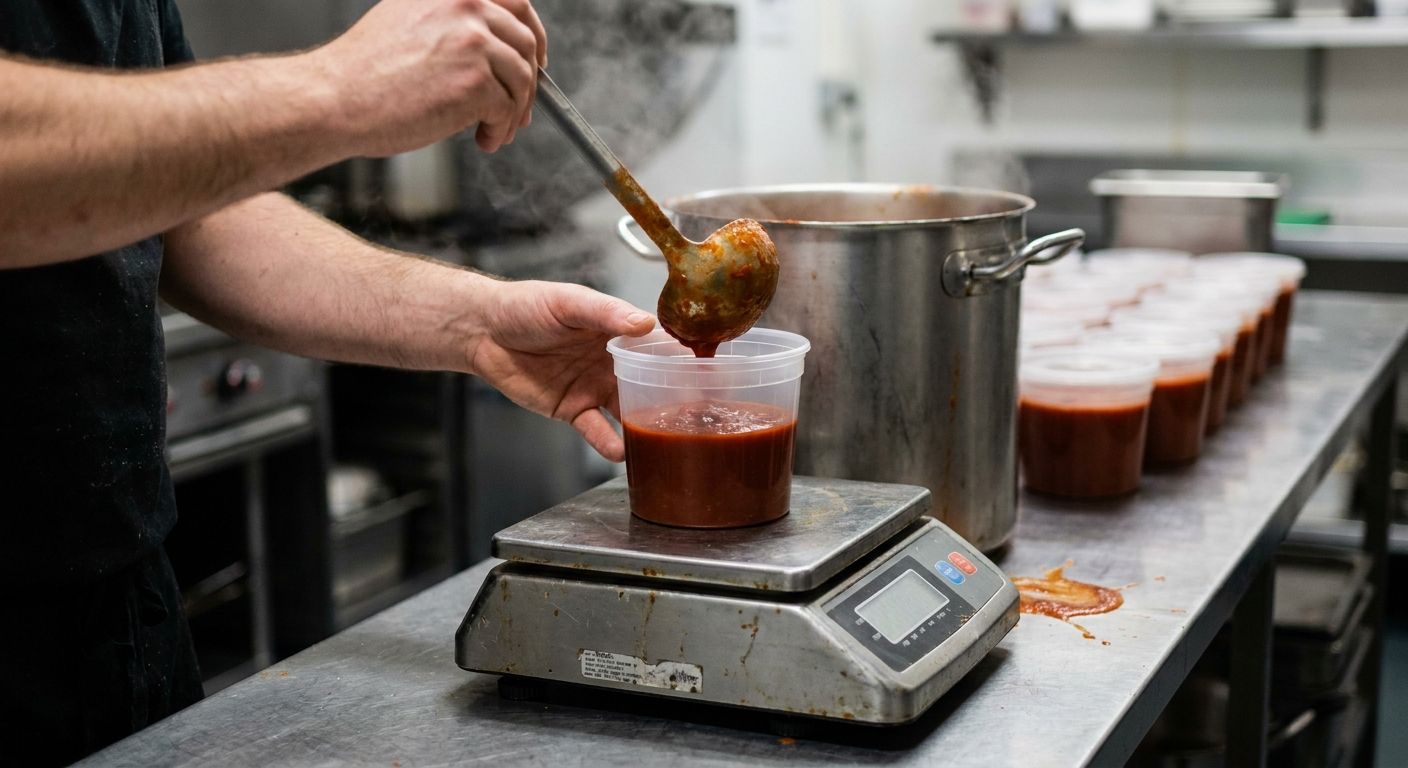
Say your group makes a 20 litre batch of house tomato sugo that goes into 14 dishes across five venues: pastas, parmas, a pizza base sauce. The batch costs $84.00 to produce, or $4.20 a litre, and a dish using 90ml carries about 38 cents of sauce.
Now tomatoes rise 18% on one invoice. Tomatoes are $38.00 of that batch, so the batch moves to $90.84 and the litre to $4.54. The 90ml serve now carries about 41 cents. Three cents a plate sounds like nothing, which is exactly why nobody recosts 14 dishes over a tomato invoice.
Run it across the group and it stops being nothing. If those 14 dishes sell 2,400 serves a week across the five venues at an average 75ml of sauce, the group uses about 180 litres a week, and the increase costs about $61 a week, or roughly $3,200 a year, from a single line on a single invoice. Whether that is fine or a problem depends on the dish, but you cannot make the call if the number never surfaces.
This is the case sub-recipes exist for: cost the sugo once as a component, and a tomato price change recosts the batch and every dish that uses it in one move. Without that structure, each dish carries a hand-typed sauce cost that starts drifting out of date the day after it is entered.
How Chefy fits
Chefy is a costing, procurement and kitchen execution platform built in Australia for multi-venue groups, and it is Square-first: it connects to your Square POS read-only, sales flow in automatically, and every item shows its margin at today's recipe cost. Nested recipes handle the sugo case above, and when an invoice reprices an ingredient the new cost cascades through every batch and menu item that uses it straight away. It will not count your cool room the way a dedicated inventory platform will: stocktakes are in there, but the job Chefy is built around is keeping the cost of every dish current and visible across venues.
If you want to pressure-test the gap first, cost one dish honestly in the free food cost calculator and check it against what your POS thinks that dish earns.
See Square sales against live recipe cost
Chefy connects to Square read-only and shows the margin on every item at current ingredient prices, across every venue.
See how it worksFAQ
Does Square do recipe costing in Australia?
Yes, at two levels. Square Recipes, in beta on Restaurants Plus and Premium plans, attaches simple recipes to menu items and calculates cost of goods sold from the ingredient unit costs you enter, though it does not support batch prep, recipes of recipes, or recipes on modifiers and multi-variation items. For deeper inventory work, Square Restaurant Inventory by MarketMan is a paid add-on with ingredient tracking, purchase orders, invoice scanning and menu costing.
Do I have to leave Square to use a dedicated costing system?
No. Costing platforms that integrate with Square, Chefy among them, connect through Square's API read-only. Square remains your till, terminals and sales system, and the costing layer reads sales from it. Nothing about how you take payment changes.
What is the difference between inventory management and recipe costing?
Inventory management counts what is on hand: stock levels, ordering, and the variance between what you should have used and what you did. Recipe costing works out what each dish costs to make at current ingredient prices, so you can price and engineer the menu from real numbers. They overlap, and the better inventory tools include some costing, but a stock count will not tell you a dish slipped below its target margin when a supplier repriced. Venues doing in-house production usually need the costing side first.
Is Square Recipes enough for a multi-venue group?
For a single venue with a simple menu it can be. For a group doing in-house production it runs out early: there is no batch prep and no recipes of recipes, so house-made components cannot be costed once and reused across dishes, recipes cannot sit on modifiers or multi-variation items, and there is no governance layer for permissions, approvals or venue-by-venue margin comparison. Groups in that position usually keep Square as the till and pair it with a dedicated costing system.
Sources
- Square (Block, Inc.), Square and MarketMan Launch Advanced Inventory Management Integration for Restaurants, April 2026
- Square Support Centre (Australia), Track ingredient costs with Square Recipes (beta), 2026
- Square Support Centre (Australia), Manage ingredient inventory with Square Restaurant Inventory, 2026
- Square Australia, Square for Restaurants pricing, August 2026
Sam · Chefy team
The Chefy team writes about margin, costing and running tighter venues across Australian hospitality.
See Chefy on your own numbers
Book a demo and we'll map your venues, team and modules and show you the monthly cost.
Book a demo