
Procurement & suppliers
Restaurant Procurement Management: 7 Margin Breaches to Catch Before Month-end
Sam
Chefy team13 min read

If you run a multi-venue group in Australia, the procurement breaches that hurt your margin most aren't the supplier price rises you saw coming. They're the inconsistencies between delivered goods prices, the invoices that follow, and the cost still showing under your dish in your costing software. The supplier swaps a 10kg box for a 9kg box at the same total price. The invoice lands 9% above the agreed list and no one queries it. A sub-recipe yield drifts from 78% to 71% across a quarter. Each one small on its own. Each one silently eating margin until the end-of-month review surfaces it.
The damage all lives in the same place. The gap between the price you paid this morning and the cost still showing up under your dish tonight. Procurement done well isn't about ordering more efficiently. It is the upstream control that keeps recipe costs live and dish-level margin protected while the back door changes daily.
This post walks through the seven margin breaches to catch before they hit the end-of-month P&L. What they look like in a multi-venue group, why they slip through, and who needs to act when they do.
Why this matters in 2026
Margin compression is hitting Australian multi-venue groups from many directions at once this year. Ingredient costs are climbing across multiple categories. Beef and lamb sit 13%+ above the same time last year, with the National Trade Lamb Indicator at record highs. Australian milk production is contracting, down 1.2% this season, while IBISWorld forecasts farmgate milk +8.5% to roughly 70.5c/L across 2025–26.
Payroll itself restructures on 1 July with Payday Super. Super contributions are due within seven business days of every pay event. The ATO has Director Penalty Notices up 136% year on year, with garnishees hitting hospitality bank accounts within weeks of arrears.
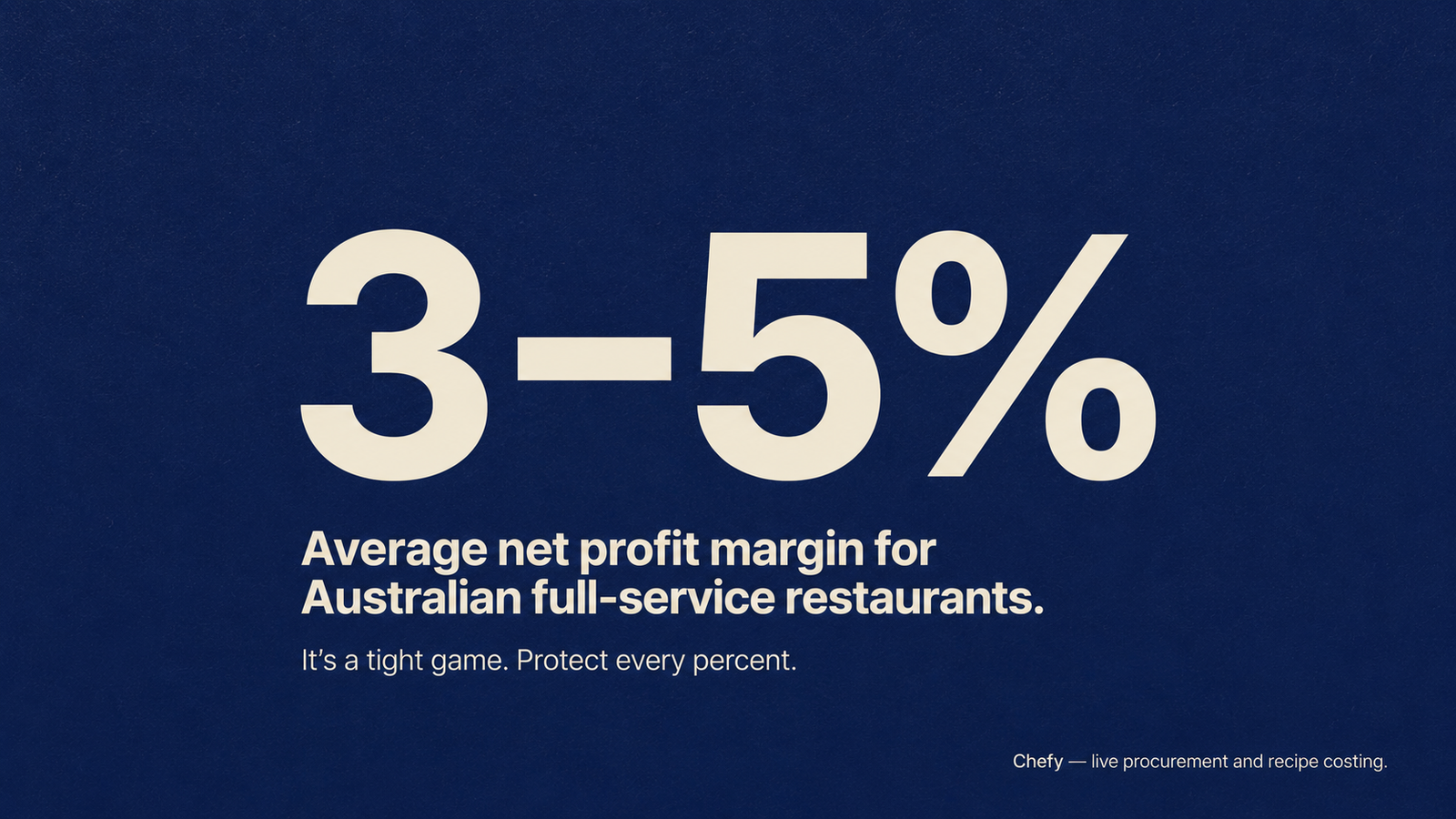
Average net profit margin for an Australian full-service restaurant is 3–5%, with food cost percentage typically sitting between 28% and 35% of menu price. CreditorWatch reported 9.6% of Australian hospitality businesses closed permanently between April 2024 and April 2025. Rising costs and softer demand sit at the centre of the story. A 2% movement in food cost is the difference between a viable year and a loss-making one. Procurement is where most of that 2% hides, and integrated procurement is what stops it from hiding for long.
What restaurant procurement management actually covers
Procurement management in a restaurant isn't just about who, what, and when you buy from. It is the routine that keeps supplier prices flowing into recipes, recipes flowing into menu prices, and menu prices holding their target margin, week after week, across every venue you run.
In practice that covers how you buy, track and review the goods and services your kitchens need to run: ingredients, beverages, packaging, supplier pricing, invoices, inventory management, stock movement and recipe costs. It covers every step of the procurement cycle from supplier selection and negotiation through purchase order, invoice reconciliation and the moment a supplier price flows into a recipe.
The procurement side and the inventory management side overlap, but they answer different questions. Procurement tells you what you paid and how that flows into the future dish cost. Inventory tells you what's currently on the shelf and what your current costs are at.
The important part is the link between buying and selling. A supplier price does not stop at the invoice. It flows into prep, portions, recipes, menu items and margin. Effective procurement management is the routine that keeps chefs, finance and operations looking at the same cost data, not separate versions across spreadsheets, supplier portals and POS exports.
In a multi-venue group, this is also where supplier relationships earn their keep. Reliable suppliers who flag price moves early, send accurate invoices and honour agreed price lists are the ones who make live costing possible, and live costing is what makes margin protection possible. Supplier performance is no longer a back-office metric; it is a margin lever. The procurement piece and the margin piece are the same problem looked at from two ends.
The 7 breaches to catch early
A good procurement tool surfaces these breaches before they hit your P&L. Here are the seven worth catching as they happen.
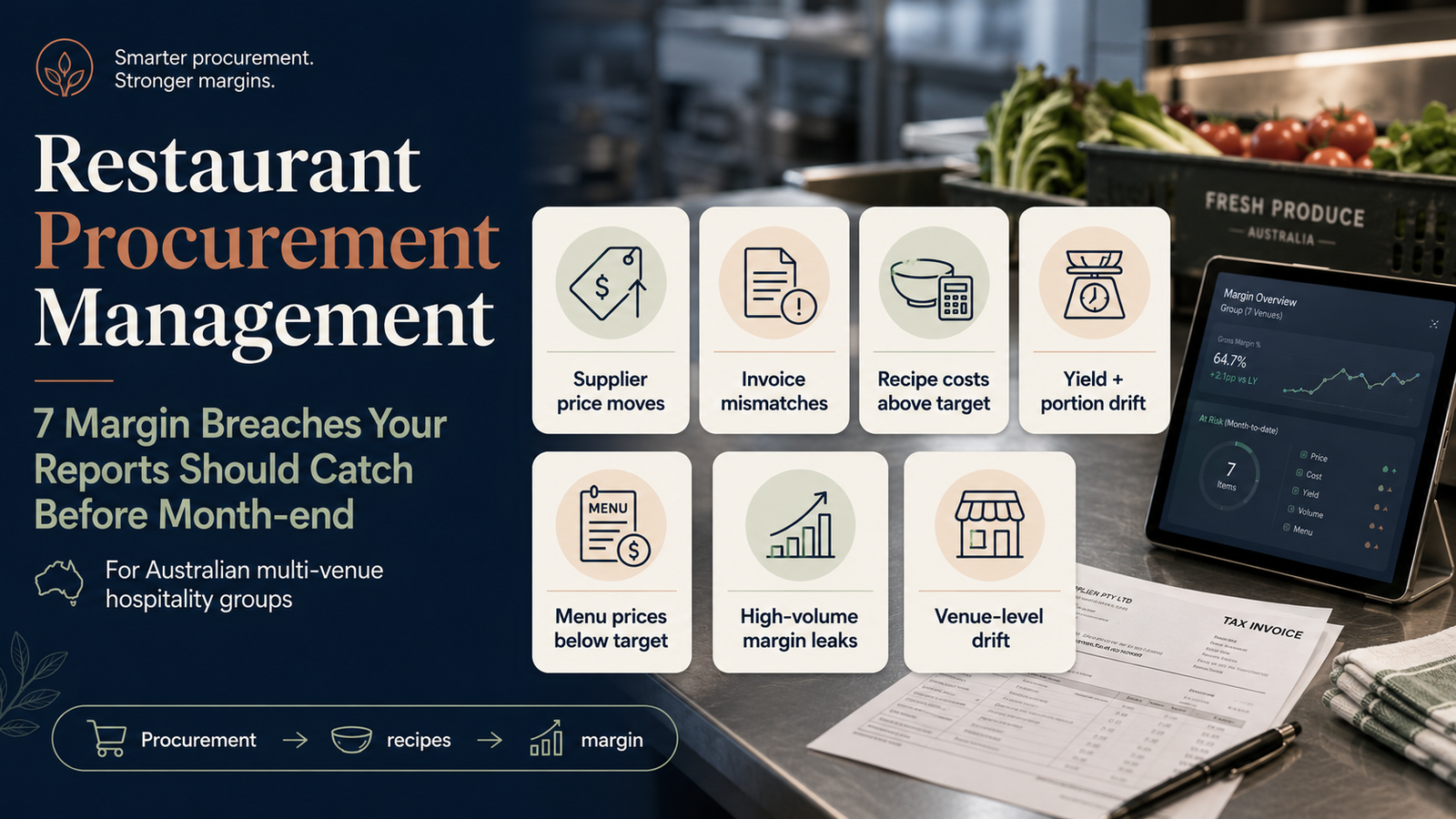
1. Supplier prices have moved above the recipe cost
This is the most common breach in any multi-venue group: a recipe costed against an October supplier price, a March invoice landing 9% higher, and the menu item still carrying the old number because no one re-costed the recipe in between. Beef, seafood, dairy, oils and flour are the usual suspects, but the one that does the damage is whatever you cook in five recipes at once. Procurement reporting that earns its keep shows which recipes and menu items are affected, not just which supplier items moved. Every percentage point your recipe cost trails the invoice price by is a percentage point of margin walking out the back door.
2. The PO, the goods received, and the invoice do not match
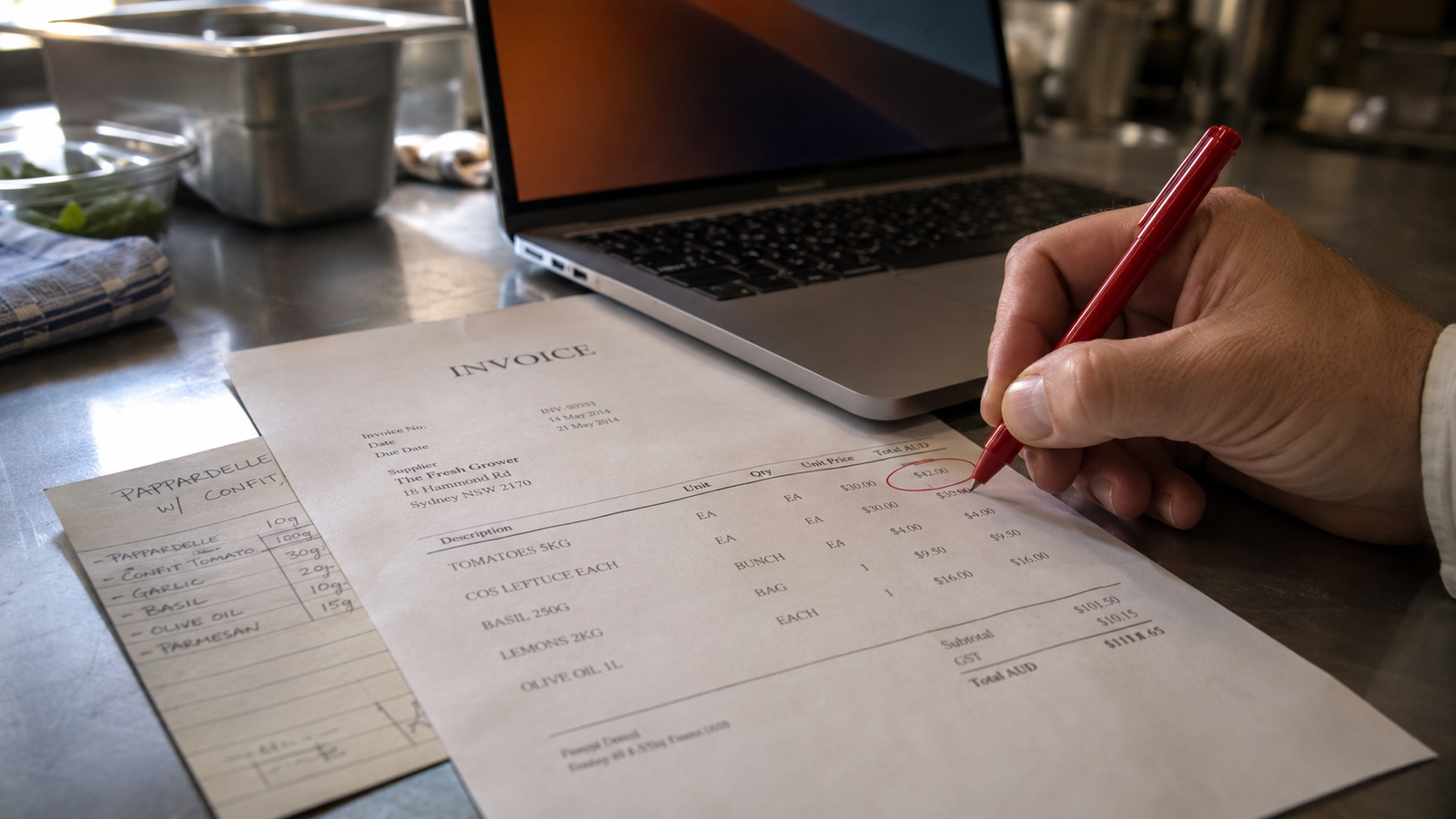
A clean procurement discipline runs a three-way reconciliation: what you ordered (the purchase order), what showed up at the back door (the goods received note), and what the supplier billed you for (the invoice). When all three match, you can trust the cost line under your recipe. When any one of them disagrees, the gap is where margin leaks. A 10kg box silently replaced with a 9kg box at the same total price won't flag itself in a simple price-list check, but a three-way match catches it the day it lands. Unit cost moved 10%, recipe cost moved with it, dish margin moved too. Broader data like the ABS Producer Price Indexes is directional context, but the three-way match is the truth.
3. Nested recipes hide cost drift
In any multi-venue kitchen, the dish on the menu is rarely a single recipe. It's a stack of component cookery: a sauce, a stock, a dough, a marinade, a dressing, a prep mix, all costed as sub-recipes nested inside the headline item. Change a supplier price for olive oil and the dressing moves, the marinade moves, the finishing oil moves, and every menu item carrying any of them shifts too. The trap: sub-recipes get updated in one place and missed in another. A caesar dressing re-costed in the salad menu but stale in the kids menu means two versions of the same dressing carrying two different dish margins. Your tool should cascade the change automatically so updating one supplier price refreshes every recipe, sub-recipe and menu item using that ingredient at once.
4. Yield and portion assumptions are no longer accurate
Not every breach starts with a supplier. A recipe looks fine on paper because it assumes a 78% yield on a beef cut. The kitchen actually trims, cooks, drains and portions to 71%. A ladle gets fuller during a busy Saturday. A garnish gets heavier across three venues. Waste sits adjacent to this. End Food Waste Australia estimates food waste costs the country more than $36 billion a year, and a chunk of that lives in hospitality. The report should help you check whether what is on paper still matches what happens at the pass, because every gram between assumed yield and actual yield is margin per cover the dish isn't earning.
5. Menu prices no longer support the target margin
Menu prices do not always move when supplier costs move. Printed menus, set menus, third-party delivery pricing and customer expectations all sit in the way. The breach to watch for is the gap that opens when costs rise and prices hold. The fix is not always a price rise. It might be the portion, the garnish, the supplier, the ingredient spec, the recipe structure, or whether the dish keeps running as a special. What matters is that procurement reporting connected to menu margins surfaces which items have slipped below target before the gap matters at the P&L.
6. High-volume items are losing margin quietly
A low-margin dish is not always the biggest problem. A pasta selling 800 times a month and losing 1.5% of food cost is doing far more damage to group margin than a low-volume dish running at 45% food cost. This is where reporting has to connect recipe costs with POS sales. Food cost percentage tells you part of the story, but contribution margin and sales mix tell you which dish to fix first. Menu engineering analysis that ignores volume misses the dishes actually moving group margin. Those are the dishes where a 1% costing improvement compounds across thousands of covers.
7. One venue is drifting from the group average
Group averages hide venue-level issues. A group can look fine in aggregate while one site is paying more for the same product, wasting more, portioning differently, selling a different mix or quietly substituting one ingredient for another. The drift might be a supplier issue at one site, a training issue at another, or a buying habit no one noticed. Venue-level procurement reporting lets you compare the same item, recipe, supplier and margin across sites, not to blame the venue, but because group margin can look healthy while one site is quietly bleeding 2–3% the group dashboard never surfaced.
Who acts when a breach shows up
Finding a breach does not always mean changing the menu price. It means the item needs the right kind of review. In a multi-venue group, the right kind depends on where the breach started.
- Finance owns it if the issue is invoice pricing, freight, credits, pack-size changes, missing rebates or a supplier billing error
- The chef owns it if it is yield, garnish, portion, prep output or recipe structure
- Operations owns it if it shows up across multiple venues, multiple suppliers or in the sales mix
The response is usually small. Update a recipe cost, query an invoice, check a portion, change a spec, watch the dish for another week. What makes it work is a single source of truth that finance, the chef and operations can each query and action from. Every cost change, recipe edit, portion adjustment or supplier swap leaves a clear audit trail showing who changed what, when, and why. The breach moves from "someone's spreadsheet that no one else can see" to a flagged item three people can act on together. That visibility, with full audit control, is what stops the same breach from quietly returning next quarter.
What a good procurement tool actually does for margin
A useful procurement tool does not bury the team in numbers. It points to the supplier, recipe, menu item or venue that needs attention now, puts a dollar value on the margin at risk, and tells you who should look at it. For multi-venue groups that usually means surfacing supplier price changes, invoice exceptions, recipe and sub-recipe cost movement, menu items outside target, contribution margin by item and venue, high-volume items under pressure, yield assumptions worth re-checking, supplier performance trends, and venues drifting from the group pattern.
It also has to be reliable enough to trust. A wrong unit conversion can make an ingredient look more expensive than it is. A duplicate supplier item splits the same product into two records. A missing sub-recipe makes a dish look cheaper than it really is. The tool's job is not perfect data. It is a useful enough picture to start the next margin review. Procurement management software that ties supplier invoices, recipes, menus and POS data into one system saves more time than any spreadsheet rebuild will, but the reason it earns its place isn't the time saving. It's that dish-level margin stays current instead of getting reconstructed after the fact.
A worked example
A four-venue casual-dining group running 110 menu items reviewed the three dishes carrying both beef and dairy. Their dish-level cost was last refreshed in January. Supplier moves through Feb–April quietly added 1.8% to the food cost line, about $14,000 of margin a quarter the management report never flagged. The fix sequence: live costing turned on, all three dishes flagged on the dashboard within a week; one supplier price renegotiated; one sub-recipe yield corrected from 78% to 71%; one dish re-engineered with a 20g portion change. Three weeks elapsed. Margin recovered ~1.4% across the affected items. Zero menu prices raised. The procurement controls did the work; margin protection was the outcome.
How Chefy fits
Chefy is built so multi-venue restaurant groups can protect margin in real time, not at the end of every quarter. Procurement is the mechanism. Supplier price lists reconciled against invoices, invoice OCR that pulls line items straight into recipes, recipe and sub-recipe costing that updates the same hour a supplier price moves, contribution margin tied to POS sales, and venue-level alerts when a single site drifts from the group pattern. The system does not make the commercial call. It surfaces the margin question early enough that finance, the chef or ops can answer it before the next P&L lands. See how it works on the features page, or compare options on pricing.
FAQ
How does procurement management protect restaurant margin?
Procurement management protects margin by closing the gap between what you paid for an ingredient and what your dish costs to make today. When supplier prices flow live into recipes, dish-level food cost stays current, contribution margin is real rather than estimated, and the items quietly losing margin surface before month-end instead of after.
What is restaurant procurement management?
Restaurant procurement management is the end-to-end procurement process that connects supplier pricing, invoices, recipes and menu margins. In a multi-venue group, it is the routine that stops a supplier price change in March from quietly eating margin until the May P&L surfaces it.
How can restaurants avoid invoice mismatches?
The reliable way is a three-way reconciliation: purchase order, goods received note, and invoice all matched against an agreed supplier price list, every week. Invoice OCR removes the human re-typing step where most mismatches creep in. When the system flags a 1.5%+ variance, the question hits your inbox on Friday instead of surfacing weeks later in the food cost percentage review.
When should a restaurant consider procurement software?
Two triggers, usually. One, you cross from one to multiple venues and spreadsheets stop being trustworthy because nobody owns the master copy. Two, supplier prices move more than once a quarter and recipe costs can't keep up. Either one means manual workflow is now actively costing you margin, and that's the point procurement software earns its place.
Why do restaurant groups need procurement management software?
Spreadsheets work when the menu is small, suppliers are stable and one person has time to keep every cost updated. Multi-venue groups run hundreds of recipes across several venues with supplier prices that move weekly. Procurement management software is the only practical way to keep recipe costs live and dish-level margin visible before month-end.
How often should you review supplier prices in a multi-venue group?
Continuously, sourced from invoices as they arrive, not on a fixed schedule. Any recipe whose underlying unit costs are older than 30 days is quietly mis-stating dish-level margin. A weekly supplier reconciliation cadence is the minimum if live invoice capture is not in place yet.
What is the difference between procurement management and inventory management?
Procurement management covers what you buy, what it cost, and how that cost flows into recipes and menu margins. Inventory management tracks what you currently hold and what's been used in production. Multi-venue groups need both, but the margin question lives in procurement, what you paid and how that flows into the dish, not in what is on the shelf.
Who owns procurement management in a small restaurant group?
In a 3–10 venue group, procurement sits across three roles. Finance owns supplier invoicing and reconciliation. The executive chef or culinary lead owns recipe and yield discipline. Operations owns the multi-venue consistency layer. Procurement management software is what lets the three look at the same numbers, and the same margin, without rebuilding spreadsheets each week.
Protect margin across every venue
If margin protection across multiple venues is the question this quarter, Chefy gives procurement the live link to recipes and menus that makes it possible.
See how it worksSources
- BeanScene, New data shows impact of rising costs on hospitality businesses
- Australian Bureau of Statistics, Producer Price Indexes, Australia, June 2025
- End Food Waste Australia, Fact library
- International Journal of Contemporary Hospitality Management, Using the contribution margin aspect of menu engineering to enhance financial results, 1997
Sam · Chefy team
The Chefy team writes about margin, costing and running tighter venues across Australian hospitality.
See Chefy on your own numbers
Book a demo and we'll map your venues, team and modules and show you the monthly cost.
Book a demo